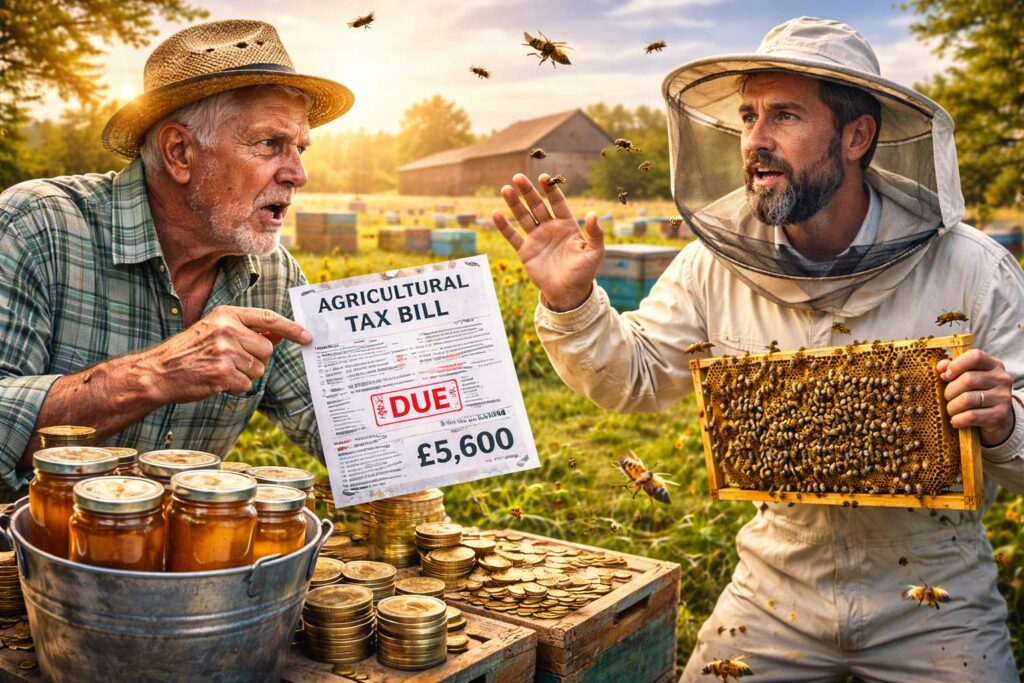

A retired landowner who allowed a local beekeeper to place hives on unused land has found himself facing an unexpected agricultural tax demand — despite receiving no rent and earning no income from the arrangement.
While the situation feels unfair to many, tax authorities generally assess land based on how it is used, not whether the owner personally profits. In many jurisdictions, once land is classified as supporting an agricultural activity, it can trigger reclassification and associated tax liabilities.
Here’s what typically happens, why beekeeping counts as agriculture, and how landowners can protect themselves.

Why Beekeeping Can Trigger Agricultural Tax
Beekeeping is legally considered an agricultural activity in most countries. Even if it is small-scale or semi-professional, it can still fall under farming classifications.
Tax authorities often assess:
- Whether the land supports food production
- Whether income is generated from that activity
- Whether the activity is registered as agricultural
- Who legally owns the land
In many cases, ownership determines tax responsibility, not operational control.
Latest Stories
 Council Tax and Agricultural Use Rules Explained for Hive Hosts, Check Your Land’s Tax Status First
Even if the beekeeper earns modest income and the landowner earns nothing, the land itself may still be deemed “in agricultural use”.
How Land Reclassification Happens
Reclassification can occur when:
- A land-use declaration is updated
- A beekeeper registers the site
- A tax authority reviews agricultural activity
- Local inspections or aerial mapping identify farming use
Once reclassified, land may be subject to:

- Agricultural land tax
- Different property tax rates
- Business or rural activity assessments
The rules vary significantly by country and region.
The Gap Between Intention and Regulation
Many informal arrangements are based on goodwill:
- No rent
- No written contract
- No formal agricultural lease
However, tax systems typically do not account for personal motives.

What feels like helping biodiversity can appear, on official records, as productive farmland.
This mismatch between neighbourly cooperation and regulatory frameworks is where disputes arise.
How to Protect Yourself Before Lending Land
A simple written agreement can significantly reduce risk.

It does not need to be complex, but it should clearly state:
- The beekeeper is the agricultural operator
- The land is provided without rent
- The beekeeper declares any income
- The landowner does not participate in production
Some beekeeping associations provide template agreements.
Practical Safeguards for Landowners
Before installing hives:

- Confirm whether beekeeping is legally defined as agriculture in your jurisdiction
- Ask if the beekeeper is registered as a hobbyist or professional
- Draft and sign a dated agreement
- Keep copies of correspondence and photographs
- Seek advice from a rural tax adviser
Early clarification is far easier than resolving disputes later.
What To Do If You Receive a Tax Notice
If a tax demand arrives:
- Do not ignore it.
- Review the land classification stated.
- Provide documentation showing the arrangement.
- Request clarification in writing.
- Seek advice from a qualified tax professional.
In some cases, it may be possible to appeal or request reassessment, depending on national law.

Why These Cases Spark Debate
Situations like this resonate because they raise broader questions:
- Should small ecological initiatives face commercial tax treatment?
- Is the law equipped to handle informal rural cooperation?
- Who should bear responsibility when land is used but not monetised by the owner?
Some argue rules must be applied consistently. Others believe tax frameworks are not designed for small-scale environmental partnerships.
Key Lessons for Landowners
| Issue | Why It Matters | Protection Strategy |
|---|---|---|
| Agricultural classification | Land use determines tax status | Confirm classification rules in advance |
| Operator responsibility | Tax often follows ownership | Define operator in writing |
| Informal agreements | Verbal deals offer no proof | Use a simple signed document |
| Late advice | Problems escalate quickly | Consult before hives are installed |
FAQs
Does lending land automatically make me liable for agricultural tax?
Not automatically, but land use classification may change depending on local law.

Does it matter if I earn no money?
Often no. Tax status may depend on land use, not profit.
Can a written agreement prevent tax?
It may not eliminate liability but can clarify roles and reduce risk.
Is hobby beekeeping treated differently?
Sometimes. Registration status and scale matter.

Should I seek professional advice?
Yes. Local tax rules vary and professional guidance can prevent costly surprises.